
Brookies Brownie Cookie Fusion
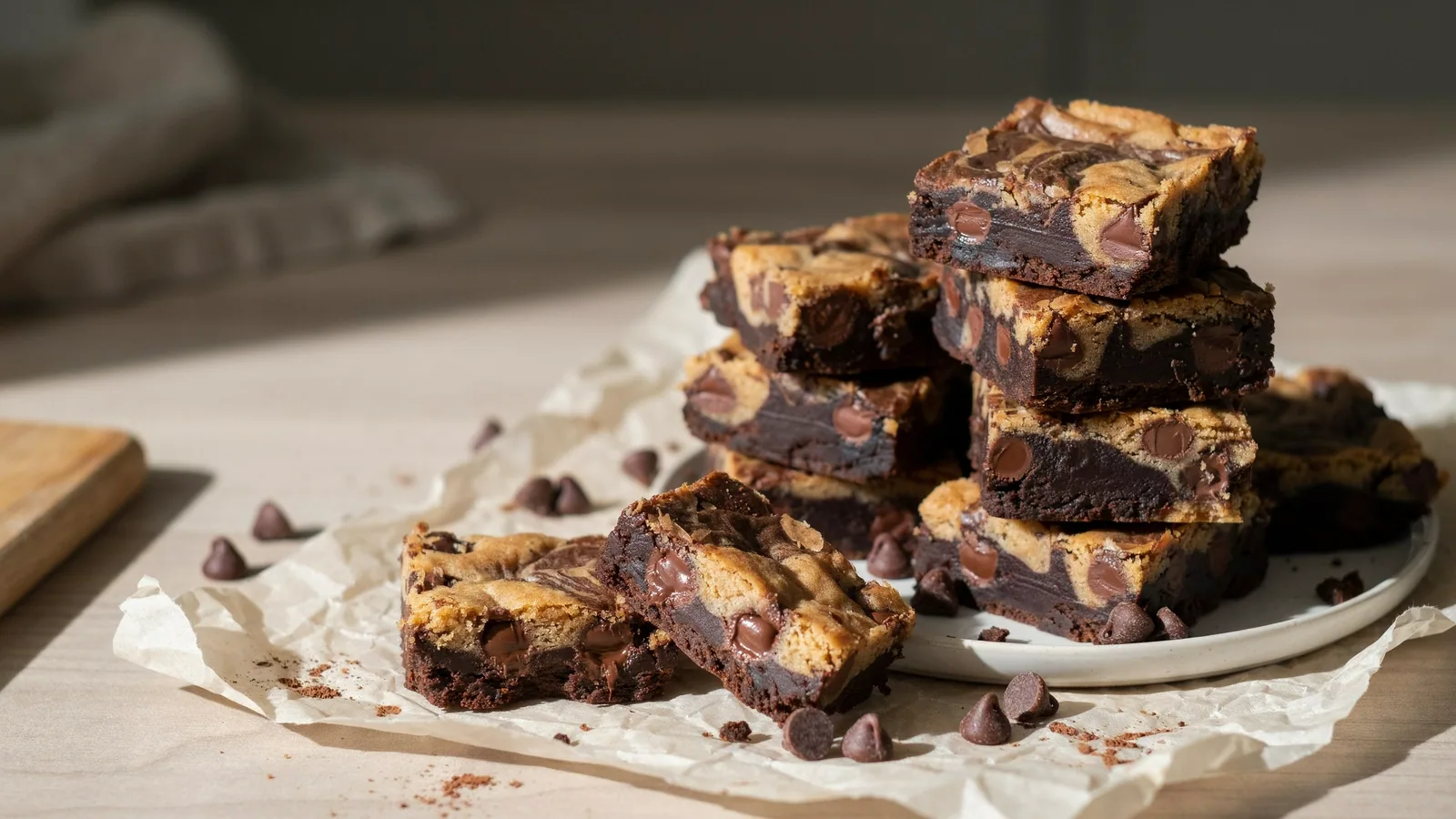
A good brookie should not taste like a generic chocolate bar with a few pale spots. You should get an actual fudgy brownie bite beside a chewy chocolate-chip cookie bite, with enough overlap to make the mash-up feel intentional. The trick is using two batters with compatible bake times and swirling them only lightly.
The Goal Is Contrast, Not a Perfect Swirl
Brookies work because the two textures stay recognizable. If you stir the batters together too thoroughly, you lose the brownie-cookie contrast and end up with one mottled chocolate batter.
Use large spoonfuls of cookie dough and brownie batter, then drag a knife through the surface only a few times. Broad patches bake more predictably than tiny intricate swirls and make the cut bars look like both desserts at once.
Why the Two Batters Can Share One Pan
The brownie batter is fluid and fudgy, while the cookie dough is thicker and holds its shape. Both bake at 350°F, but they signal doneness differently. That is why the recipe uses a brownie-heavy spot for the toothpick test and the color and surface of the cookie sections as a second cue.
The brownie portion uses melted chocolate plus cocoa for depth without requiring an unusually long bake. The cookie side uses melted butter, brown sugar and an extra yolk to stay chewy rather than cakey.
Ingredient Notes That Affect Texture
- Semisweet chocolate. Melted chocolate gives the brownie portion a denser, fudgier base than cocoa alone.
- Brown sugar. It appears in both components because its moisture helps both the brownie and cookie sections stay chewy after cooling.
- Egg yolk in the cookie dough. The extra yolk adds richness and chew without adding as much water as another whole egg.
- Metal 9×13 pan. Metal gives more predictable edge setting than glass, which can bake more slowly and retain heat longer.
Make party food easier.
Get practical recipes, useful swaps and seasonal ideas delivered to your inbox.
Do Not Overmix Either Batter
Once flour goes into the brownie batter, fold only until the dry streaks disappear. Do the same with the cookie dough. Neither component benefits from prolonged mixing at that stage, and overworking the flour makes the finished bars less tender.
How to Assemble the Pan
Start with roughly two-thirds of the brownie batter spread over the base. Drop the thicker cookie dough in heaping spoonfuls so some brownie remains exposed, then use the remaining brownie batter to fill a few gaps. This gives the bars a marbled top without forcing you to spread sticky cookie dough into a perfect layer.
Run a knife through in broad S-curves only a handful of times. You are connecting the patches, not homogenizing them.
How to Know When Brookies Are Done
This is where many brookies get dry. A toothpick from a brownie-heavy section should carry a few moist crumbs. If it comes out coated in liquid batter, keep baking. If it comes out bone-dry and the cookie sections are deeply browned, the bars have probably gone farther than necessary.
The cookie areas should look set on top and lightly golden around their edges. Remember that the entire slab continues cooking from retained heat for a few minutes after it leaves the oven.
Cool Before You Cut
Warm brookies are tempting, but the brownie portion is still setting as the pan cools. Cutting immediately compresses the center and smears the two textures together. Let the slab cool completely, then lift it out by the parchment and cut on a board.
For party-size pieces, 24 bars is a useful yield. If you want larger dessert squares, cut 16 instead.
Make-Ahead and Transport
These are easier to transport than frosted bars because there is nothing on top to slide or smear. Bake them a day ahead, cool completely and store airtight. Transport in a single layer or separate stacked layers with parchment.
They also freeze well once completely cooled. Freeze cut bars in an airtight container with parchment between layers, then thaw at room temperature before serving.
Common Problems
The cookie sections are dry before the brownies look done: the cookie dough may have been broken into pieces that were too small. Larger dollops protect the cookie interior and create better contrast.
The pan looks like one uniform batter: it was swirled too much. Next time stop after a few broad passes.
The center collapses when cut: either the brownies were genuinely underbaked or the slab was cut while still warm. Cool completely before judging the final texture.
Brookies Brownie Cookie Fusion
Fudgy brownie and chewy chocolate-chip cookie batters baked together into marbled brookie bars.
Ingredients
- 10 tablespoons (142 g) unsalted butter, divided
- 4 oz (113 g) semisweet chocolate, chopped
- 3/4 cup (150 g) granulated sugar
- 1/2 cup (110 g) packed light brown sugar, divided
- 3 large eggs, divided
- 1 large egg yolk
- 2 1/2 teaspoons vanilla extract, divided
- 1 cup (120 g) all-purpose flour, divided
- 1/3 cup (28 g) unsweetened cocoa powder
- 3/4 teaspoon fine salt, divided
- 1/4 teaspoon baking powder
- 3/4 teaspoon baking soda
- 3/4 cup (128 g) semisweet chocolate chips
Instructions
- Heat oven to 350°F (175°C). Line a 9×13-inch metal baking pan with parchment, leaving overhang on two sides, and lightly grease the exposed pan.
- For the brownie batter, melt 6 tablespoons butter with the chopped semisweet chocolate over low heat, stirring until smooth. Remove from the heat and whisk in the granulated sugar and 1/4 cup brown sugar.
- Whisk in 2 eggs and 1 teaspoon vanilla until glossy. Fold in 1/2 cup flour, the cocoa powder, 1/2 teaspoon salt and the baking powder just until no dry streaks remain.
- For the cookie dough, melt the remaining 4 tablespoons butter and let it cool until warm rather than hot. Whisk with the remaining 1/4 cup brown sugar, the remaining egg, egg yolk and 1 1/2 teaspoons vanilla.
- Fold in the remaining 1/2 cup flour, remaining 1/4 teaspoon salt and the baking soda, then fold in the chocolate chips. The cookie dough will be thicker than the brownie batter.
- Spread about two-thirds of the brownie batter across the prepared pan. Drop the cookie dough over it in heaping spoonfuls, leaving brownie visible between the dollops. Spoon the remaining brownie batter into some of the gaps.
- Run a butter knife through the top only a few times to create broad swirls without blending the two batters into one uniform mixture.
- Bake 28–34 minutes, until the edges are set and a toothpick inserted into a brownie-heavy section comes out with a few moist crumbs, not wet batter. A cookie-heavy section should look lightly golden and set on top.
- Cool completely in the pan on a wire rack, about 1 hour. Lift out using the parchment and cut into 24 bars.
Do not wait for a toothpick to come out completely clean from the brownie sections; a few moist crumbs keep the brownie portion fudgy. Use broad dollops and only a few knife passes so the cookie and brownie remain visually distinct.
NoshParty recipes are carefully researched for clarity, practicality and real-kitchen use.
Never wonder what to bring again.
Get practical party recipes, seasonal ideas and crowd favorites delivered straight to your inbox.